

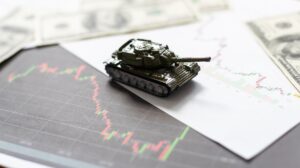
 Investors are once again asking how the war is impacting the stock markets after the U.S. and Israel launched coordinated strikes across Iran on February 28, sharply escalating tensions in the Middle East. Israel has also expanded its offensive campaign against Hezbollah in Lebanon. Iran responded with retaliatory attacks across Israel and several Gulf states, raising fears of a broader regional conflict and potential disruption to global oil supply.
U.S. President Donald Trump has called for Iranians to overthrow their government.
As geopolitical risk surged, global stocks fell and volatility spiked—while Canada’s TSX showed surprising resilience, supported by a sharp jump in crude prices. The market reaction offers a clear, real-time example of how war impacts stock markets, sector performance, and investor sentiment.
How the War Is Impacting Stock Markets: The Immediate Market Reaction
Before the attacks, U.S. stocks were off to their worst start to a year since 1995. The war with Iran has not helped matters, as fears are mounting that the war could expand throughout the Middle East.
On Monday, March 2, the first trading day since the war started, global stocks were down. In the opening hours of trading, the S&P 500 slipped 0.5%, the Dow Jones Industrial Average dropped 0.6%, and the Nasdaq was down 0.3%.
In the U.S., Wall Street’s fear gauge, the CBOE Volatility Index (VIX) ripped 25% higher on Monday morning to an intraday high of 25.24, its highest level since November 2025. Since 1990, the average daily close for the VIX has been around 19.5. At the start of 2026, the VIX stood at 14.51.
Internationally, Europe’s benchmark, STOXX 600 (an index that follows companies across 17 countries in the European Union) dropped 1.65% and Japan’s Nikkei 225 tumbled 1.35%. In Canada, the response of the Toronto Stock Exchange (TSX) was a little more muted with the index up slightly, hovering at 34,415, near its record high.
Why Are Crude and Energy Stocks Up?
Stocks did fall on the TSX, but gains in energy stocks offset those declines. In the opening hours of trading, the index’s energy sub index, the S&P/TSX Capped Energy Index, surged more than three percent. Energy is the third largest sector in the TSX, accounting for 16% of sector weight. The index is up around 8.5% year to date.
By comparison, the S&P 500 is more weighted toward technology stocks. Global stocks are taking a big hit, but U.S. stocks are also contending with weakness in tech and artificial intelligence (AI) stocks and elevated stock valuations. The S&P 500 has advanced just 0.6% in 2026.
Energy stocks around the world were up on March 2, with Brent Crude, the international benchmark, jumping as much as 13% to $82.00 per barrel, its highest trading level in 14 months. There are growing concerns that the closure of the Strait of Hormuz, one of the world’s most important shipping areas for global trade, would cut off some oil shipments.
West Texas Intermediate, the U.S. benchmark, enjoyed a 6.8% bump, hitting $71.58 per barrel, its highest trading level since June 2025. Western Canadian Select, the Canadian benchmark, is mostly flat at $54.67 per barrel. Western Canadian Select is a heavy bitumen that comes from Alberta and trades at a discount to West Texas Intermediate, which is made up of lighter, sweeter oil that is easier and cheaper to refine.
How Will Stocks React to the War with Iran Longer-Term?
How will stocks perform during the current war with Iran?
Overall, this will depend on the severity and length of the war. Right now, we’re seeing crude, precious metals (gold and silver), and defensive plays getting a near-term boost.
Longer-term, we could also see investors move out of riskier stocks, such as tech stocks and smaller stocks, and into safer, less volatile ones. However, should there be signs of a ceasefire with Iran, we could see stocks become less volatile very quickly.
Learn-to-Trade.com, Canada’s Leader in Stock Market Trading Courses
For active traders and investors, periods of heightened volatility like this can create both risk and opportunity. Understanding how geopolitical events influence crude prices, sector rotation, and overall market sentiment is critical to making informed trading decisions.
Learn-to-Trade.com is Canada’s oldest and leading provider of stock market trading courses. Over the years, the experts at Learn-to-Trade.com have helped tens of thousands of Canadians, of every skill level, learn how to trade more confidently and profit more consistently.
We also provide a unique, Lifetime Membership that allows members to re-attend any part of the program as often as they’d like.
To learn more about Learn-to-Trade.com’s stock market trading course, contact us at 416-510-5560 or by e-mail at info@learn-to-trade.com.

